SACC vs ASHRAE BTU on a Portable AC Spec Sheet
A portable air conditioner carries two cooling ratings and only the smaller one sizes a room. Here is how the federal SACC test gets to that number, and what LG, Whynter and Midea publish beside it.
This article is a documentation review: it is based on the vendors' own published pages, checked on the date shown. We may earn a commission from some links; it never affects what we recommend.
A portable air conditioner carries two cooling numbers, and only one of them sizes a room. The large ASHRAE figure comes from a bench measurement. The smaller SACC figure, set by a federal test procedure, subtracts the heat a hose pulls back into the room. This guide reads both numbers on current spec sheets from LG, Whynter and Midea, and checks the coverage claims against the sizing table ENERGY STAR publishes. Every figure comes from the makers' own pages or the federal test procedure, checked October 11, 2026. Where a page omits a number, the guide says so.
The smaller number is the one the federal test produces
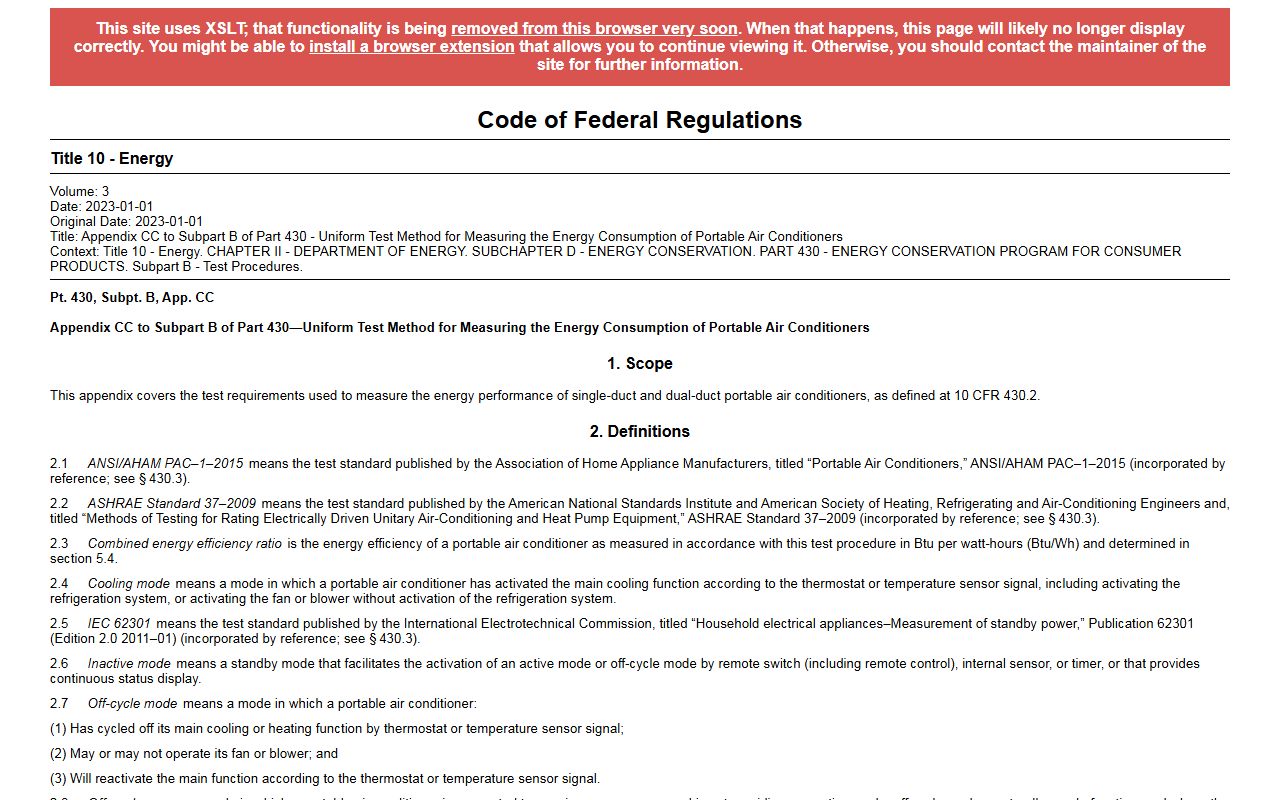
SACC stands for seasonally adjusted cooling capacity, and it is a calculation rather than a reading. Appendix CC to subpart B of 10 CFR part 430, checked October 11, 2026, states the formula as "SACC = ACC95 x 0.2 + ACC83 x 0.8".
That is a weighted average of two runs. Twenty percent comes from the hot run, eighty percent from the milder one. The appendix sets the hot run at a 95 F condenser inlet and the milder run at 83 F.
Neither run is the raw capacity. For a single-duct unit the appendix subtracts duct heat transfer and infiltration air heat transfer from the measured capacity. One hose exhausts indoor air, outside air leaks back in, and that penalty is counted.
The same appendix defines the efficiency metric as the combined energy efficiency ratio, measured "in Btu per watt-hours (Btu/Wh)". None of the four product pages read for this guide printed a CEER value.
LG states the size of the gap in writing
One maker explains the split on the product page itself. The LG LP0725WSSM page says that "The DOE BTU rating may be up to 42% lower when compared to the previous ASHRAE BTU method for the same product."
That model is listed at 7,300 BTU SACC and 11,000 BTU ASHRAE, covering 300 sq ft. By editorial calculation the SACC figure sits 33.6 percent below the ASHRAE figure. The page publishes no dBA, no wattage and no warranty period.
The larger LG LP1419IVSM is listed as "10,000 BTU (SACC) / 14,000 BTU (ASHRAE)" and "Cools Up To 450 sq. ft." By editorial calculation that gap is 28.6 percent. Its page also omits noise, power draw and warranty.
Treat the ASHRAE number as a headline and the SACC number as the specification. A listing that prints only the bigger figure describes a machine you cannot size. The same split drives what dehumidifier pint ratings actually mean.
A dual-hose unit loses less, and the gap shows it
The infiltration penalty shrinks when the condenser draws its air from outside. The Whynter ARC-14S page, a dual-hose unit, lists "14,000 BTU" ASHRAE and "9,500 BTU" SACC, a gap of 32.1 percent by editorial calculation.
The Midea Duo page lists "14,000 BTU / 12,000 BTU SACC" for its dual-hose inverter model, up to 550 sq ft. That is a 14.3 percent gap, the narrowest of the four units read here.
One warning about that figure. The Midea page carrying the full specification is the Canadian one. The US category page, read the same day, lists no models or capacities at all. Read the page for your own country before buying.
- LG LP1419IVSM: 14,000 ASHRAE, 10,000 SACC, 450 sq ft claimed, 28.6 percent gap.
- LG LP0725WSSM: 11,000 ASHRAE, 7,300 SACC, 300 sq ft claimed, 33.6 percent gap.
- Whynter ARC-14S: 14,000 ASHRAE, 9,500 SACC, 500 sq ft claimed, 32.1 percent gap, dual hose.
- Midea Duo: 14,000 ASHRAE, 12,000 SACC, 550 sq ft claimed, 14.3 percent gap, dual hose inverter.
All four gaps sit inside the "up to 42%" ceiling LG prints, and no page explains why its own gap is the size it is. A single-hose machine carries the larger penalty by design.
Check the coverage claim against the ENERGY STAR table
Makers set their own square-footage claims. The ENERGY STAR sizing table for room air conditioners, checked October 11, 2026, pairs 250 to 300 sq ft with 7,000 BTU/h, 450 to 550 sq ft with 12,000 BTU/h, and 550 to 700 sq ft with 14,000 BTU/h.
Hold the four units against it. The LG at 7,300 SACC claiming 300 sq ft matches the table almost exactly. The Whynter at 9,500 SACC claiming 500 sq ft is about 2,500 BTU/h short of the 12,000 the table asks for.
The Midea at 12,000 SACC claiming 550 sq ft sits on the boundary between two rows. The table also states its capacities "are calculated based on an 8-foot ceiling", so a taller room needs more than the row suggests.
ENERGY STAR lists four adjustments to apply before buying. They are easy to run on paper and they change the answer more than brand choice does.
- Heavily shaded room: reduce capacity by 10 percent.
- Very sunny room: increase capacity by 10 percent.
- More than two occupants: add 600 BTU per additional person.
- Kitchen: increase capacity by 4,000 BTU.
An "up to" coverage figure with no stated ceiling height, window load or occupancy is a ceiling, not a promise. Air purifier listings play the same trick with air changes per hour, as set out in how to read an air purifier spec sheet.
Home fragrance listings do it with room size, which is why how to read a scent diffuser spec sheet starts with coverage and then shrinks it. The pattern is the same in every category where one number is cheap to print.
Noise, watts and warranty are where the pages diverge most
Only one page publishes a noise range. Whynter lists "<51 low/ <56 high" dBA, with no measuring distance stated. Midea prints a single "43 dBA" figure, and neither LG page prints any dBA at all.
Power draw appears once. Whynter lists "1300 Watts / 11.6 Amps" as maximum consumption, and Midea gives voltage but no wattage. Without watts or CEER on three of four pages, running cost cannot be compared from the spec sheets alone.
Warranty is the third gap. Whynter states "one year warranty and three year warranty on the compressor". Midea states a "1 Year Limited Warranty", noting six years for Quebec. The two LG pages state no period.
Frequently asked questions
Which BTU number should I use to size a portable air conditioner?
Use the SACC figure. It is the output of the federal test procedure in appendix CC to subpart B of 10 CFR part 430, which subtracts duct and infiltration heat before weighting two runs at 95 F and 83 F.
Why is the SACC rating so much lower than the ASHRAE rating?
Because a vented portable unit pushes indoor air outside, so outside air leaks back in. LG's own product page states the DOE rating "may be up to 42% lower" than the old ASHRAE method for the same product, as of October 2026.
Does a dual-hose portable AC really test better?
On these four spec sheets, yes. The dual-hose Midea Duo shows a 14.3 percent gap between its ASHRAE and SACC figures by editorial calculation, against 33.6 percent for the single-hose LG LP0725WSSM. The pages do not explain the difference themselves.
What does CEER mean on a portable air conditioner?
Appendix CC defines the combined energy efficiency ratio as efficiency measured "in Btu per watt-hours (Btu/Wh)". Higher is better. None of the LG, Whynter or Midea product pages read on October 11, 2026 printed a CEER value.
How many BTU do I need for a 400 square foot room?
ENERGY STAR's table pairs 350 to 400 sq ft with 9,000 BTU/h at an 8-foot ceiling, as of October 2026. Add 10 percent for a very sunny room, 600 BTU per occupant above two, and 4,000 BTU for a kitchen.
Bottom line
A complete portable AC spec sheet states the SACC capacity, the ASHRAE capacity, a CEER value, a noise range with its measuring distance, the wattage and a warranty period. As of October 2026, none of the four pages read here publishes all six.
Size by SACC against the ENERGY STAR table, not by the coverage claim, and email for the missing CEER and warranty figures before checkout. Reading the footnote rather than the headline pays off the same way in how to read printer page yield.
One advertised number that splits as soon as conditions change is also the story in what a USB-C charger's wattage rating means and in what router speed numbers actually mean.
Sources
- 10 CFR part 430, subpart B, appendix CC - portable air conditioner test procedure (checked Oct 11, 2026)
- LG LP0725WSSM portable air conditioner product page (checked Oct 11, 2026)
- LG LP1419IVSM DUAL Inverter portable AC product page (checked Oct 11, 2026)
- Whynter ARC-14S dual hose portable AC product page (checked Oct 11, 2026)
- Midea Duo smart inverter portable air conditioner (Canada page) (checked Oct 11, 2026)
- ENERGY STAR - room air conditioners sizing table (checked Oct 11, 2026)