What Dehumidifier Pint Ratings Actually Mean
A pint rating is a 24-hour figure measured at one temperature, and the federal test changed that temperature. Here is how to read the number, and the larger second number sitting next to it.
This article is a documentation review: it is based on the vendors' own published pages, checked on the date shown. We may earn a commission from some links; it never affects what we recommend.
A dehumidifier pint rating looks like a capacity and behaves like a test score. It is the water the machine removes in 24 hours at one fixed temperature and humidity. The federal procedure changed that temperature, so the same hardware now prints a smaller number than it did before 2020. Some listings also print a second, much larger pint figure measured under hot and soaking conditions. This guide reads both, reproduces the official conversion tables, and checks the coverage claims against ENERGY STAR's own sizing advice, all read on October 11, 2026.
The pint number is a 24-hour figure measured at 65 F
Start with what the number measures. TCL's support page, checked October 11, 2026, states it plainly: "Dehumidifier pint rating is based on how much moisture can be removed within a 24 hour period." It is a rate, not a tank size.
The conditions come from appendix X1 to subpart B of 10 CFR part 430, read on govinfo. Portable dehumidifiers are measured at a 65 F dry-bulb temperature and 60 percent relative humidity, with stated tolerances. Whole-home units are measured at 73 F instead.
The same appendix defines the efficiency metric. Integrated energy factor is "a measure of energy efficiency of a dehumidifier calculated by dividing the water removed from the air by the energy consumed, measured in liters per kilowatt-hour (L/kWh)".
So a pint rating answers one question: how much water comes out in a day in a 65 F room at 60 percent humidity. A warmer room yields more, a cold basement less.
A rule change cut the number, not the machine
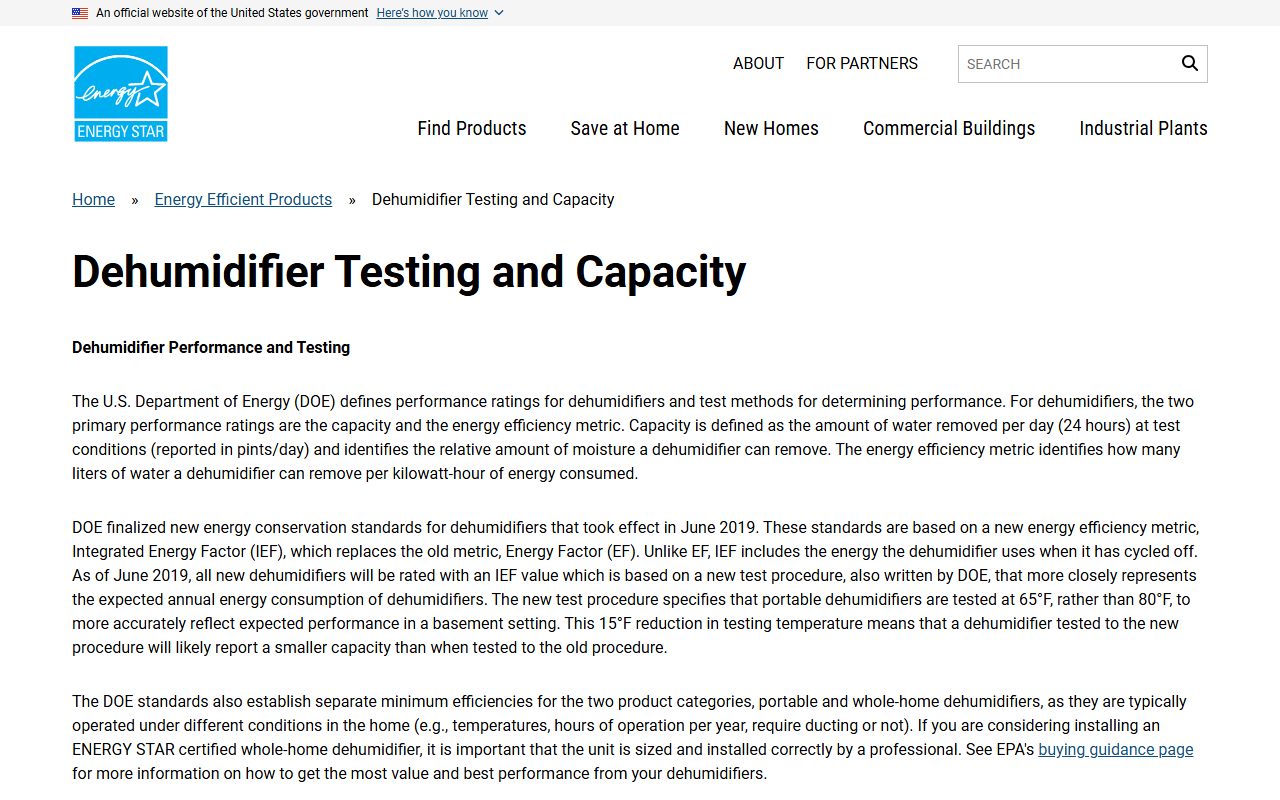
Old and new models differ because of a test change, not a redesign. The ENERGY STAR dehumidifier testing page says the new procedure specifies testing at 65 F "rather than 80 F, to more accurately reflect expected performance in a basement setting".
The consequence is stated on the same page: a unit tested to the new procedure "will likely report a smaller capacity than when tested to the old procedure". The standards took effect in June 2019 and makers began using the revised approach in early 2020.
The efficiency metric changed at the same time. Integrated energy factor replaced the older energy factor, and the page notes the key difference: "IEF includes the energy the dehumidifier uses when it has cycled off". An idling compressor now counts against the score.
This is the same pattern as the portable air conditioner rules, where a new federal procedure produced a lower published capacity for unchanged hardware. That story is told in SACC vs ASHRAE BTU on a portable AC spec sheet.
Two official conversion tables disagree with each other
If you are replacing a pre-2020 unit, you need a conversion. Two sources publish one, and they do not match. ENERGY STAR's table gives these old-to-new equivalents for portable units: 30 pints becomes 20, 50 pints becomes 30, and 70 pints becomes 40 to 45.
TCL's support page agrees on the first two rows and not the third. It states that "a dehumidifier manufactured and sold prior to 2020 with a rating of 70 pint is now equivalent to a 50 pint dehumidifier".
The gap matters at the top of the range. A buyer replacing an old 70-pint machine is pointed at a 40-to-45-pint unit by ENERGY STAR and a 50-pint unit by TCL. Oversizing costs money; undersizing never catches up.
- Old 30 pints: 20 pints per ENERGY STAR, 20 pints per TCL.
- Old 50 pints: 30 pints per ENERGY STAR, 30 pints per TCL.
- Old 70 pints: 40 to 45 pints per ENERGY STAR, 50 pints per TCL.
- Whole-home 80 pints: 70 pints per ENERGY STAR; TCL publishes no whole-home row.
- Whole-home 140 pints: 115 pints per ENERGY STAR.
Watch for a second, larger pint figure at 95 F and 90 percent
Some product names carry two pint numbers, and only one of them is the federal rating. The hOmeLabs dehumidifier range, checked October 11, 2026, prints pairs such as "50 Pint" with "MAX 120 Pint" and "95 F, 90% RH" attached to the larger figure.
The pattern repeats. An 8-pint model is listed with a 24-pint maximum, a 25-pint model with 64 pints, a 32-pint model with 80 pints and a 40-pint model with 104 pints. Each maximum is about two to three times the rating.
On the 50-pint Wi-Fi model's own page, listed at $269.99, the maximum carries its test condition and the 50-pint figure does not. The page states no temperature or humidity behind the headline rating, and no dBA, warranty or tank volume.
A number with its conditions attached is a specification. A number without them is a claim. The same two-figure habit shows up in what router speed numbers actually mean, where the headline is a sum of theoretical maxima.
Size from the damp-room table, not the square-footage claim
Coverage claims on these listings are large. The hOmeLabs 50-pint model is described as covering up to 7,000 sq ft, its 32-pint model up to 4,500 sq ft, with no humidity level or ceiling height stated.
ENERGY STAR sizes by dampness instead. Its guidance pairs a slightly to moderately damp room, 50 to 75 percent humidity, with 20 to 30 pints per day for small to medium rooms.
A very damp room at 75 to 90 percent humidity calls for 25 to 40 pints, and a wet room at 90 to 100 percent calls for 30 to 50 pints. Large rooms sit above each of those ranges.
Read the two together and the picture changes. A 50-pint unit sits at the top of ENERGY STAR's range for a wet room, a very different brief from drying 7,000 sq ft. Match pints to dampness first.
Coverage figures that quietly assume best-case conditions are the oldest trick in appliance listings. The equivalent in air treatment is the air-change rate hidden behind a square-footage claim, unpacked in how to read an air purifier spec sheet.
Check the efficiency figure and the cold-room limit
Two more numbers decide whether the machine suits the room. The ENERGY STAR dehumidifiers page says a certified unit "uses 20% less energy" than a similarly sized conventional model, and measures that in litres of water per kilowatt-hour.
The second is a temperature floor. The same page warns that "Frost can form on the condensing coils if the air temperature drops below 65 degrees". That is the temperature the federal test itself uses.
ENERGY STAR also sets the target the machine is working towards: indoor relative humidity "between 30% and 50%". A hygrometer costs a few dollars and tells you which row of the dampness table you are actually in.
Frequently asked questions
Is a 50-pint dehumidifier the same as an old 70-pint one?
Roughly, and the two official tables disagree on how roughly. ENERGY STAR equates an old 70-pint unit with a new 40-to-45-pint unit, while TCL's support page equates it with a 50-pint unit. Both were checked October 11, 2026.
Why did dehumidifier pint ratings drop?
The federal test temperature fell from 80 F to 65 F to reflect basement conditions, per ENERGY STAR. Cooler air holds less moisture, so the same machine removes fewer pints in the test. The standards took effect in June 2019 and labels changed in early 2020.
What does MAX 120 pint mean on a 50-pint dehumidifier?
It is the output under hot, soaking conditions. hOmeLabs attaches "95 F, 90% RH" to its maximum figures, as of October 2026. The federal rating is measured at 65 F and 60 percent humidity, so the two numbers are not comparable.
What size dehumidifier do I need for a wet basement?
ENERGY STAR pairs a wet room at 90 to 100 percent humidity with 30 to 50 pints per day for small to medium rooms, and more than 50 pints for large rooms, as of October 2026. Measure the humidity before choosing.
Will a dehumidifier work in a cold garage?
ENERGY STAR warns that frost can form on the condensing coils below 65 degrees. Since 65 F is also the federal test temperature, a garage in winter sits under the conditions the rating describes. Look for a model that states low-temperature operation.
Bottom line
A complete dehumidifier spec sheet states the pint rating with its 65 F test condition, an integrated energy factor in litres per kilowatt-hour, a tank volume, a noise figure and a warranty period. The listings read here publish the first and little else.
Size by the ENERGY STAR dampness table, treat any second pint figure as a hot-and-wet maximum, and ask for the missing IEF in writing. The same discipline applies to supply costs in how to read printer page yield.
Ratings that split the moment real conditions arrive are covered in what a USB-C charger's wattage rating means.
Where a maker leaves out the test condition entirely, the omission is the finding. That is the reading applied to coverage claims in how to read a scent diffuser spec sheet as well.
Sources
- ENERGY STAR - dehumidifier testing and capacity (test change and conversion table) (checked Oct 11, 2026)
- ENERGY STAR - dehumidifiers product page (sizing, IEF, frost warning) (checked Oct 11, 2026)
- 10 CFR part 430, subpart B, appendix X1 - dehumidifier test procedure (checked Oct 11, 2026)
- TCL support - dehumidifier testing standards and product pint capacity (checked Oct 11, 2026)
- hOmeLabs - dehumidifiers range (pint pairs and coverage claims) (checked Oct 11, 2026)
- hOmeLabs - 50 pint Wi-Fi dehumidifier product page (checked Oct 11, 2026)