MeDo Review: What a Working App Actually Costs in Credits
MeDo publishes what most AI app builders hide: a per-action credit price list. A default build message costs 40 credits, publishing costs 20, and a source download costs 300. This review converts those credits into dollars from MeDo’s own documentation, checked October 22, 2026, and names what the vendor leaves unpublished.
This article is a documentation review: it is based on the vendors' own published pages, checked on the date shown. We may earn a commission from some links; it never affects what we recommend.
MeDo does something few AI app builders do: it publishes a price list. A message costs 40 credits on the default setting, publishing an app costs 20, and downloading your own source code costs 300.
That turns the buying question from "can it build an app" into "what will it cost per month". This review reads MeDo’s own credit, billing, publishing and export documentation, checked October 22, 2026.
Verdict. MeDo suits one person shipping a small, real product — a booking site, a client portal, an internal dashboard — who accepts credits as a running cost. It is a poor fit for anyone who needs a fixed monthly bill.
The reason is that MeDo runs two meters. Building is charged per message; a live backend is charged per day. The second meter is the one that catches people out, and MeDo’s own FAQ says so.
Three reasons to buy it
- The price list is public and itemized. The credit documentation names a figure for every action, including the ones most vendors leave vague, such as source-code download and native app packaging.
- The exit is documented, not just promised. The export guide lists exactly what the download contains and what it does not, down to the stripped service_role key.
- You can test the whole loop for $0. New accounts get 100 credits on sign-up plus 80 a day for logging in, and the FAQ states no credit card is required to start.
Three reasons to hold off
- A Free-plan backend pauses after five inactive days. Keep-alive, the setting that prevents it, is a Pro feature.
- The plan table is not on a public pricing page. As of October 22, 2026, medo.dev/pricing resolves to a sign-in screen; the numbers live in the documentation and inside the app.
- A Pro subscription buys credits at the same rate as the smallest credit pack. Twenty dollars buys 2,000 credits either way, so you are paying for the unlocked features, not a volume discount.
Prices and plan limits change, and the live plan table sits behind sign-in. Check the current terms before you commit a card.
See MeDo’s current plans →Affiliate link. VibeVerify may earn a commission if you subscribe; it does not change a figure in this review.What MeDo actually is
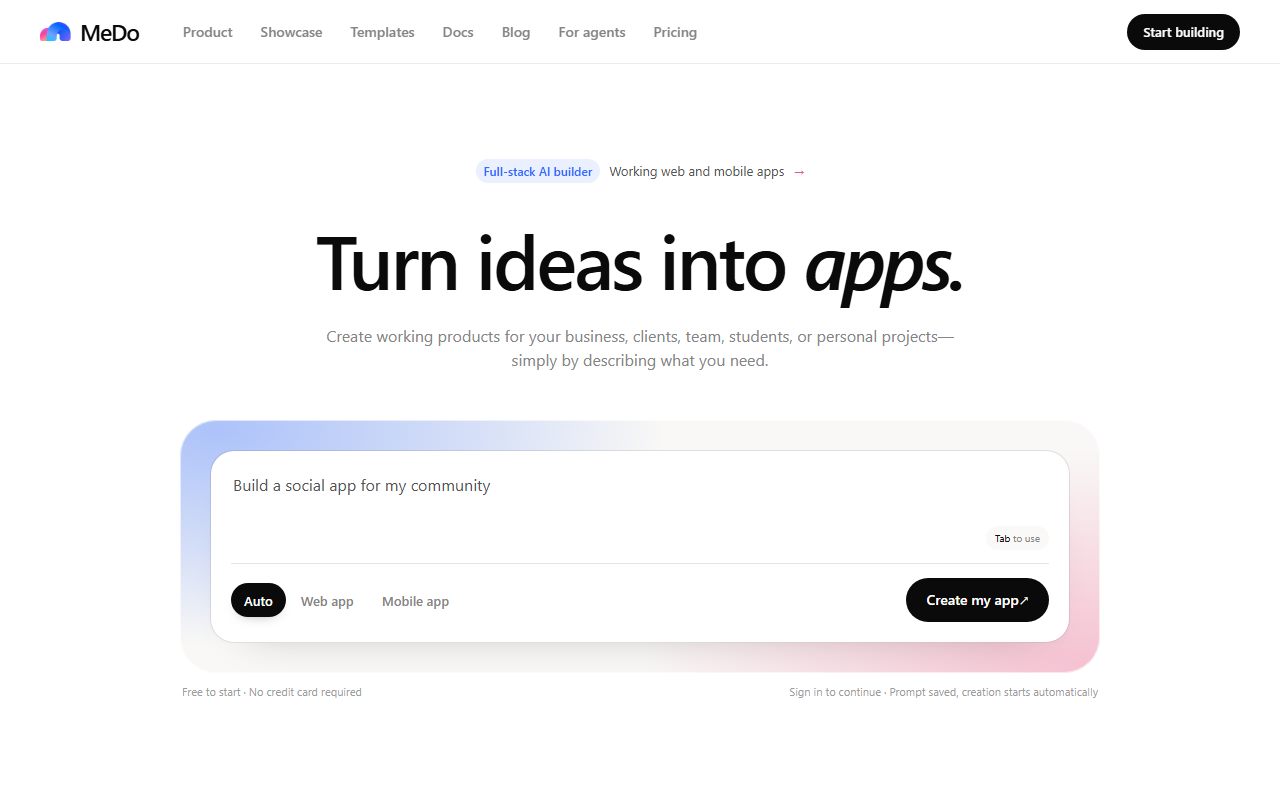
MeDo is a prompt-to-product generator, not a page builder. Its public agent instructions file, read October 22, 2026, says the generated product "can include the interface, user accounts and permissions, backend APIs and logic, a connected database, and a permanent free MeDo app URL".
Three build targets are listed: Auto, Web and Mobile. The same file states that generation starts only after sign-in, and that the public landing page does not generate the app itself.
What gets generated is named in the export guide rather than on the marketing pages. The downloadable package is a Vite, TypeScript and React frontend plus a Supabase backend, with the table structure, row-level security policies and database functions in one schema file.
That matters more than any feature list. A platform that names the stack it emits is one you can price an exit from, the same way a stated test condition makes a number comparable in what IP ratings cover.
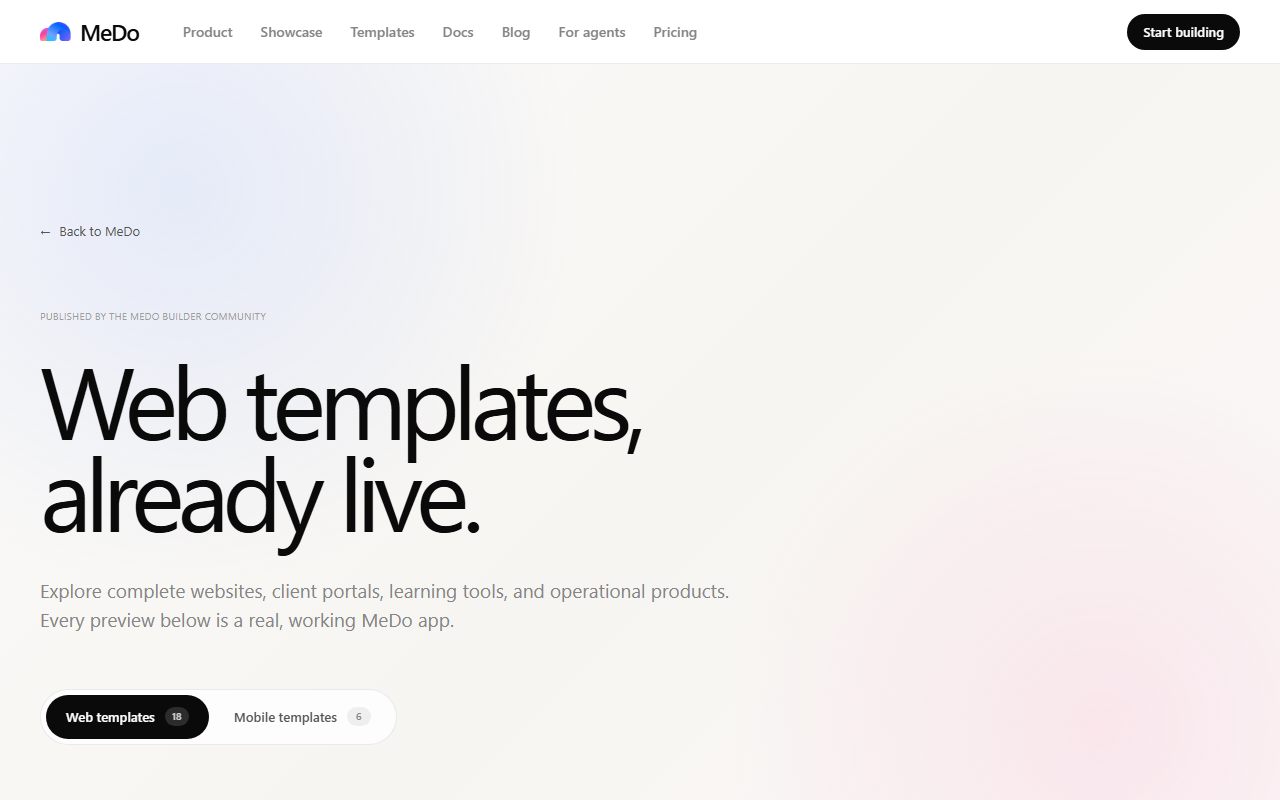
The template gallery is small and open about its size. The templates page showed 18 web templates and 6 mobile templates when we read it on October 22, 2026, and states every preview is a real, working MeDo app.
Who MeDo is best for, and who should skip it
The credit model decides this answer, not the feature set.
Best for:
- A solo founder validating one idea who needs a working sign-up, database and admin view in an afternoon.
- A freelancer or agency handing a client a small internal tool, since projects can be moved between spaces and handed over as source code.
- A consultant building a client portal where the realistic alternative is a spreadsheet and three email threads.
- A teacher or operations manager who needs a form, a record store and an access rule, not a design system.
- Anyone who wants to own the result later: the download is documented, and the FAQ states you can export form submissions and run the project yourself.
Skip it if:
- You need a predictable bill. Daily backend charges make the monthly total depend on how many apps you keep live.
- You need a security review. MeDo’s FAQ is explicit that its automated analysis is a functional test and "not a security scan", and that it does not scan for vulnerabilities or leaked keys.
- You want a published uptime figure before signing. An SLA is named only on the Enterprise plan, with no number attached — a claim without a test condition, as in robot vacuum suction claims.
Every action has a credit price, and MeDo publishes the list
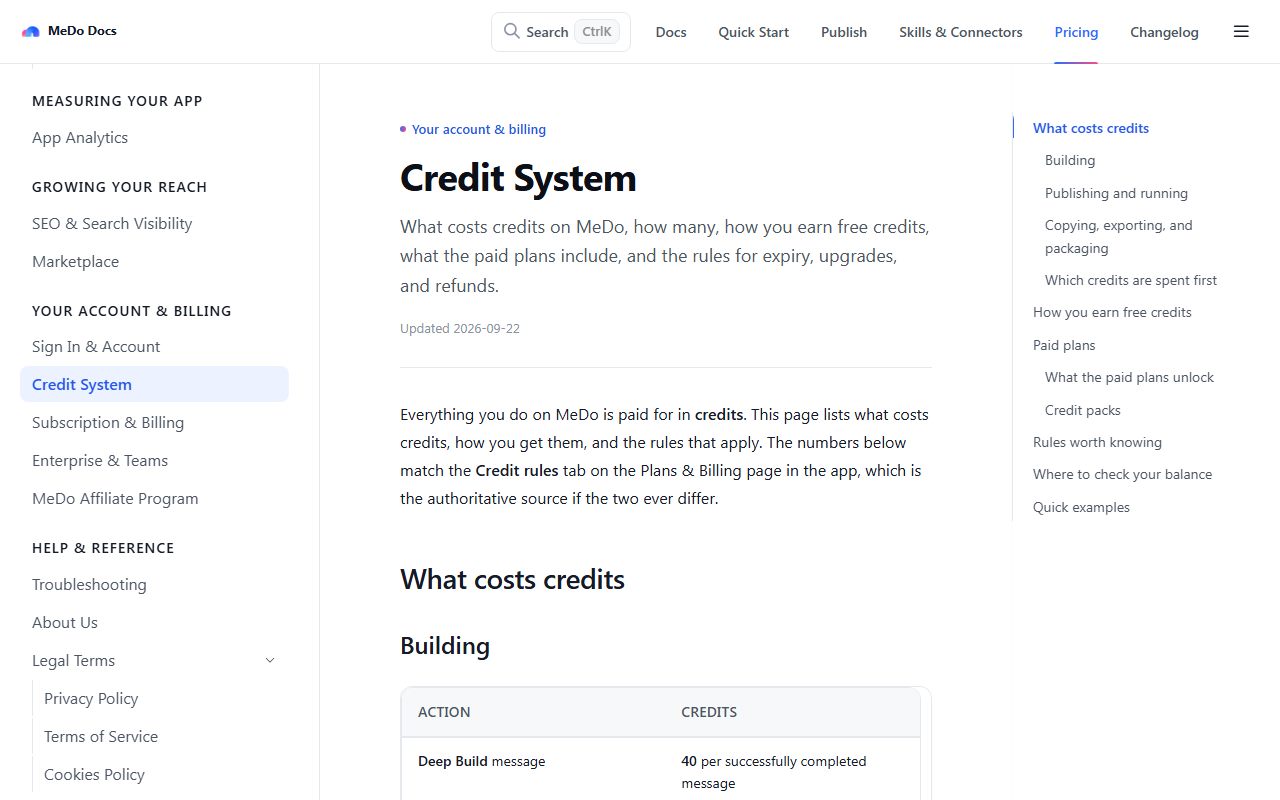
This is the part worth reading before the marketing copy. The credit system page, updated September 22, 2026 and read October 22, 2026, prices each action separately.
| Action | Credits (as of October 22, 2026) |
|---|---|
| Deep Build message (the default) | 40 per completed message |
| Fast Build message | 10 per completed message |
| AI Quality Analysis | 60 per analysis |
| Publish an app | 20 per app |
| Backend, per app per day | 15 Low, 30 Medium, 50 High, 300 Ultra |
| Custom prefix on the published link | 300 per change |
| Download source code | 300 per download |
| Android packaging / iOS packaging | 300 / 500 per operation |
| Copy an app from the Marketplace | 100 per copy |
Two details soften that table. Deep Build and Fast Build differ fourfold per message, and the documentation states that a failed generation or conversation attempt returns the credits charged for it.
One detail sharpens it. Skills — the connectors for Stripe, Slack, Notion and the rest — may charge per call, and the credit page says each price appears on that skill’s own card rather than in any published list.
Counting the catalog is the only way to size the gap. By our count of the documentation’s connector catalog on October 22, 2026, 28 services are named, and not one of their per-call prices is public.
A price list that is complete except for the part you use daily behaves like a headline figure with its test condition missing, which is the pattern in SACC versus ASHRAE BTU on a portable AC.
It also hides a second unit. A credit is not a dollar, and microSD speed class labels show what happens when a vendor prices in a unit only it controls.
The plans: $0, $20 and $50 a month, plus credit packs
Three consumer plans and one team plan, per the subscription and billing page, updated September 20, 2026 and read October 22, 2026.
| Free | Pro | Max | |
|---|---|---|---|
| Price | $0 | $20 / month or $200 / year | $50 / month or $500 / year |
| Subscription credits | — | 2,000 / month | 6,000 / month |
| Daily login bonus | 80 / day, up to 400 / month | 100 / day, up to 3,000 / month | 100 / day, up to 3,000 / month |
| Most credits per month | 400 | 5,000 | 9,000 |
| Backend keep-alive | No | Yes | Yes |
| Download source code | No | Yes | Yes |
| Custom domain | No | Yes | Yes |
| Asset library / per file | 100 MB / 50 MB | 1 GB / 500 MB | 1 GB / 500 MB |
Convert the ceiling into work and the plans separate fast. At 40 credits a Deep Build message, the Free plan’s 400-credit monthly ceiling is 10 such messages; Pro’s 5,000 is 125 and Max’s 9,000 is 225. That arithmetic is ours, from the vendor’s figures.
Turning a vendor’s unit into the unit you actually buy in is the same move as turning watt-hours into hours in why laptop battery claims disagree.
Now compare the subscription with a pack. Credit packs start at $20 for 2,000 credits, exactly what Pro’s $20 grants. Pro is not a volume discount; it is the key to keep-alive, custom domains, source download and watermark removal.
Max is the better per-credit deal of the two. Fifty dollars for 6,000 subscription credits works out near $0.0083 each against Pro’s $0.01, by our arithmetic from the published prices.
Volume only helps at the top of the pack ladder. The largest listed pack is $2,000 for 260,000 credits, about $0.0077 each, roughly 23% below the $20 pack’s cent-per-credit rate. Pack credits are valid for 365 days.
Annual billing is the vendor’s own 17%. The subscription page prints Pro’s yearly price as $200, or $16.67 a month, and says paying yearly saves about 17%.
Teams pay on a different sheet. The Enterprise plan is listed at $39.90 a month for 2 seats, then $19.95 per seat, with 2,000 subscription credits a month, a 10 GB shared asset library and everything in Pro except the daily login bonus.
MeDo’s plan table lives inside the product, and the documentation says the in-app version wins if the two ever differ.
Open MeDo and check the plans →Affiliate link. The figures above came from pages dated September 2026 and read October 22, 2026.The published-app trap: a free backend pauses after five idle days
This is the most expensive thing to learn late. Publishing costs 20 credits and puts the app on a MeDo address, usually in under a minute, per the app release page read October 22, 2026.
Then the second meter starts. If the app has a backend — bookings, orders, accounts, form records — a Free-plan backend is paused after five consecutive inactive days.
The failure is quiet, which is what makes it costly. The documentation states the pages still open; nothing can be read or saved until the backend is running again.
The fix is a paid feature. Backend keep-alive is available on Pro and Max, and the documentation says the Free plan cannot switch backend plans at all.
Keeping it alive carries a daily price. Backend plans are charged per app per day at 15, 30, 50 or 300 credits for Low, Medium, High and Ultra, within the included quotas.
Run that across a month and the shape changes. One Low backend is about 450 credits in a 30-day month, roughly a quarter of Pro’s 2,000 subscription credits; an Ultra backend is about 9,000, more than Max grants. Both figures are our arithmetic.
Storage sits on top. Disk above 2 GB costs 6 credits per GB per day, and object storage above 10 GB costs 2 credits per GB per day on full usage, with the included allowance not subtracted once you pass it.
A per-day charge that only bites after you ship is the software version of a running cost hidden behind a headline capacity, the reading applied in the portable power station numbers that matter.
You are not locked in, but the exit costs 300 credits
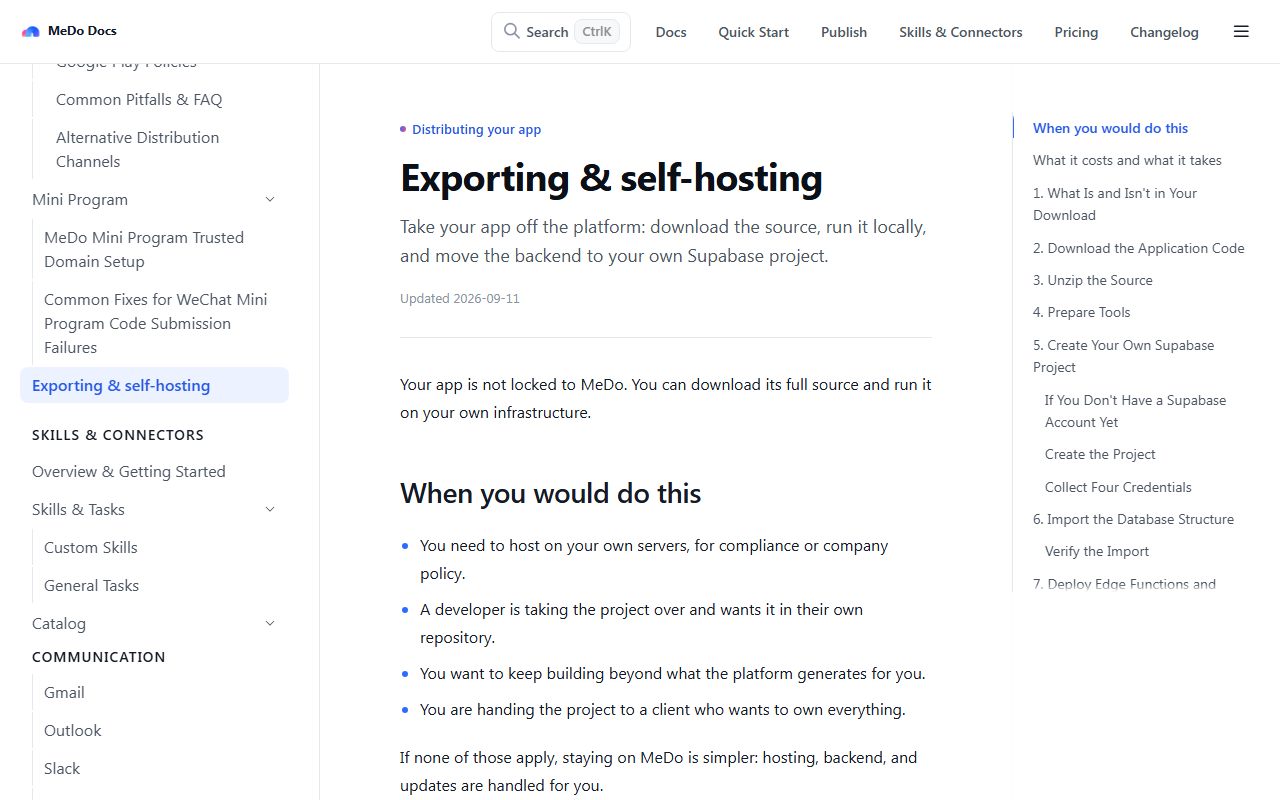
MeDo documents its own exit in unusual detail, and the detail is where the cost sits. The exporting and self-hosting guide, updated September 11, 2026, prices a source download at 300 credits and restricts it to Pro and Max.
What the download contains, per that page: the Vite, TypeScript and React frontend; the table structure, row-level security policies, database functions and triggers in a schema file; the raw migrations; edge function code; and an environment file.
What it leaves behind matters more: no row data, no files from storage, no edge function secrets, and no service_role key, which the platform strips. Row data must be exported from the source database, which the guide notes most users cannot access.
The environment file is the trap inside the trap. Its Supabase URL and anon key still point at MeDo’s hosted backend, so an unmodified download keeps talking to the platform rather than to your own database.
The guide’s own estimate is refreshingly blunt: "Budget an hour for a first migration and expect to need a terminal."
Read that as the real switching cost. A vendor that prints what its export omits is doing what a good spec sheet does, the habit this site applies to SSD endurance ratings and to printer page yield.
What MeDo does not publish
Everything above comes from documentation, which makes the gaps as informative as the figures.
- A public pricing page. As of October 22, 2026, medo.dev/pricing resolves to a sign-in screen; the plan table is in the documentation and in Plans & Billing inside the app.
- The authoritative numbers. The credit page states the in-app Credit rules tab "is the authoritative source if the two ever differ", so the published table is explicitly secondary.
- Per-call skill prices. Each connector’s price is shown on its card in the Skill Center, not in any public list.
- Backend quota detail. Daily backend rates apply "within the included quotas", yet only the 2 GB disk and 10 GB object-storage thresholds are quantified.
- Uptime, latency or an SLA number. An SLA is named for Enterprise; no figure is attached to it.
- Any user, revenue or success-rate figure. None appears on the pages read for this review.
We did not measure generation speed, output quality or uptime ourselves. This review grades what the vendor publishes and what it declines to publish, the method set out on our about page and used across our comparison pages.
Frequently asked questions
Is MeDo free?
There is a Free plan at $0. New accounts get 100 credits on sign-up plus 80 a day for logging in, capped at 400 a month, and the FAQ states no credit card is needed to start. Checked October 22, 2026.
How much does MeDo cost per month?
Pro is $20 a month or $200 a year; Max is $50 a month or $500 a year, per the subscription page read October 22, 2026. Enterprise is listed at $39.90 a month for two seats, then $19.95 per seat.
How many apps can I build on 2,000 credits?
It depends on messages, not apps. At 40 credits per Deep Build message and 20 per publish, 2,000 credits is about 49 Deep Build messages plus one publish, by our arithmetic. A live backend then costs 15 to 300 credits a day.
Why did my published MeDo app stop saving data?
The likeliest cause is the backend pausing after five consecutive inactive days on the Free plan. The documentation says pages still open but nothing reads or writes until it runs again. Backend keep-alive, a Pro feature, prevents it.
Can I download my MeDo app’s source code?
Yes, on Pro and Max, for 300 credits per download. The package holds the React frontend, the database structure and edge functions, but no row data, no stored files and no service_role key, per the export guide read October 22, 2026.
Does MeDo check my app for security problems?
No. Its FAQ states the automated AI Quality Analysis is a functional test of flows, forms and console errors, and is "not a security scan". MeDo does not scan for vulnerabilities or leaked keys. Checked October 22, 2026.
Is a Pro subscription cheaper than buying credit packs?
Not per credit. Pro’s $20 grants 2,000 subscription credits, and the $20 pack grants 2,000 as well. Pro’s value is keep-alive, custom domains, source download and watermark removal, plus the larger daily login bonus.
Bottom line
MeDo earns its place for one job: shipping a small, real, data-backed product quickly, as one person or a two-seat team, with a documented way out. Price it as two meters, not one.
Buy it if you will publish one or two apps, you can live with a variable monthly total, and $20 for keep-alive and a custom domain reads as cheap against building the same thing yourself.
Skip it if you need a fixed bill, a security audit, or a published uptime figure before you sign. None of the three exists on the pages read for this review.
We have not graded MeDo against competing builders here, and we will not imply a ranking we did not do. The figures above come from vendor pages dated between September 11 and September 22, 2026, read on October 22, 2026.
Every number here came from a page that can change tomorrow. Open the plan table before you spend anything.
Check MeDo’s current pricing →Affiliate link. VibeVerify may earn a commission; the verdict above was written from the vendor’s documentation, not from the commission.Sources
- MeDo Docs — Credit System (checked Oct 22, 2026)
- MeDo Docs — Subscription & Billing (checked Oct 22, 2026)
- MeDo Docs — Publishing a release (checked Oct 22, 2026)
- MeDo Docs — Exporting & self-hosting (checked Oct 22, 2026)
- MeDo Docs — Enterprise & Teams (checked Oct 22, 2026)
- MeDo Docs — FAQ (checked Oct 22, 2026)
- MeDo Docs — Using build modes (checked Oct 22, 2026)
- MeDo — agent instructions (skill.md) (checked Oct 22, 2026)
- MeDo — Web and mobile templates (checked Oct 22, 2026)