What Ceiling Fan CFM and Airflow Efficiency Mean
Ceiling fan listings print an airflow figure and an efficiency figure, and the two will not divide into each other. The federal test method explains why, and shows which speed is missing from the page.
This article is a documentation review: it is based on the vendors' own published pages, checked on the date shown. We may earn a commission from some links; it never affects what we recommend.
A ceiling fan listing usually carries two numbers: airflow in cubic feet per minute and airflow efficiency in CFM per watt. Both come from a federal test method, and neither is measured the way most buyers assume.
This guide reads that test method, then holds two current product pages from one maker against it. Both pages publish more than most rivals, and both leave out the same row.
Every figure below comes from the Code of Federal Regulations, ENERGY STAR or the maker's own pages, checked October 23, 2026. Where a page omits a figure, this guide says so.
The federal method defines both numbers in one place
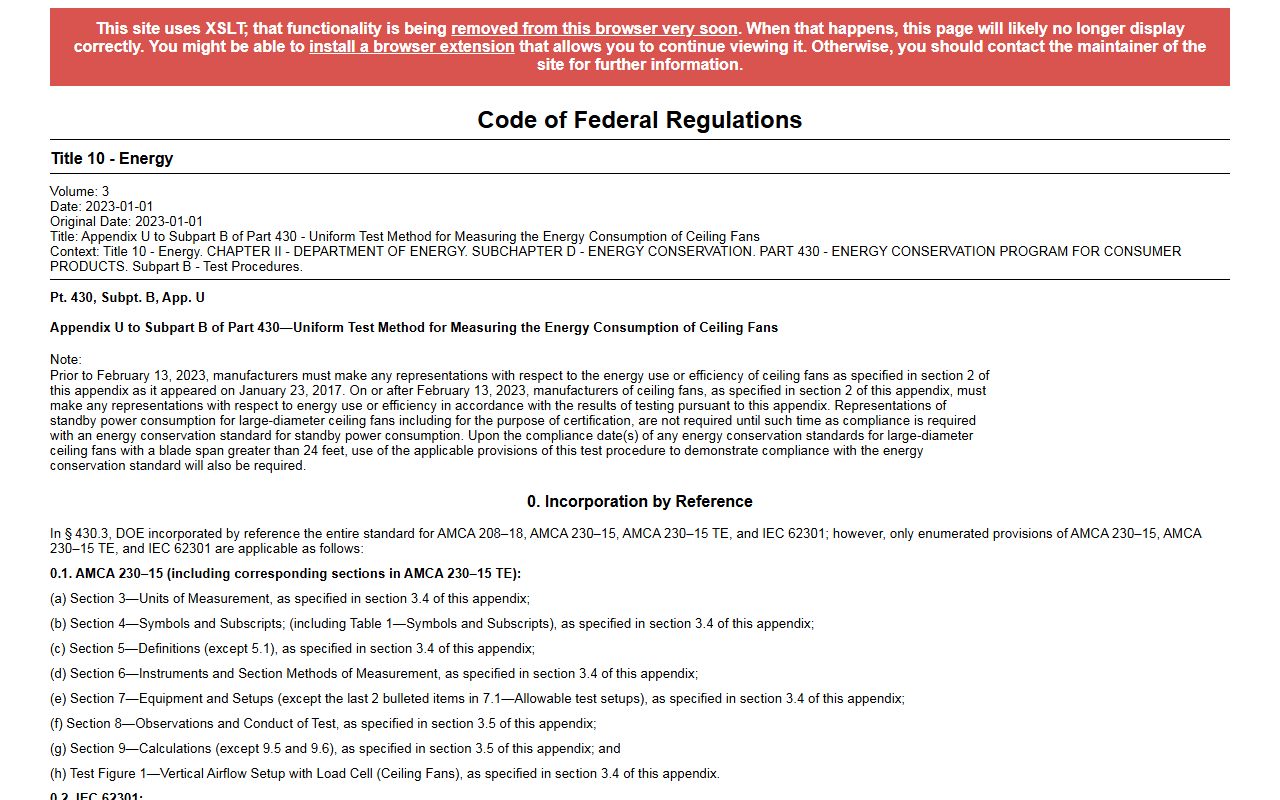
Appendix U to subpart B of 10 CFR part 430 is the "Uniform Test Method for Measuring the Energy Consumption of Ceiling Fans". It defines the airflow figure and the efficiency figure separately.
Airflow is "the rate of air movement at a specific fan-speed setting expressed in cubic feet per minute (CFM)". The phrase to notice is "at a specific fan-speed setting".
Ceiling fan efficiency is "the ratio of the total airflow to the total power consumption, in units of cubic feet per minute per watt (CFM/W)". The word there is total, not high-speed.
The appendix then sets which speeds get tested, and it is not the same for every fan. The category a fan falls into decides how many measurements stand behind its published numbers.
- High-speed small-diameter fans: tested at high speed only.
- Low-speed small-diameter and very-small-diameter fans: tested at both low speed and high speed.
- Large-diameter and high-speed belt-driven fans: tested at high speed, and at "40 percent or the nearest speed that is not less than 40 percent speed".
So the ordinary household fan is a two-speed measurement, and its efficiency figure pools both runs. A single CFM figure on a product page cannot by itself be the input to that efficiency figure.
The labelling rule points at the same appendix
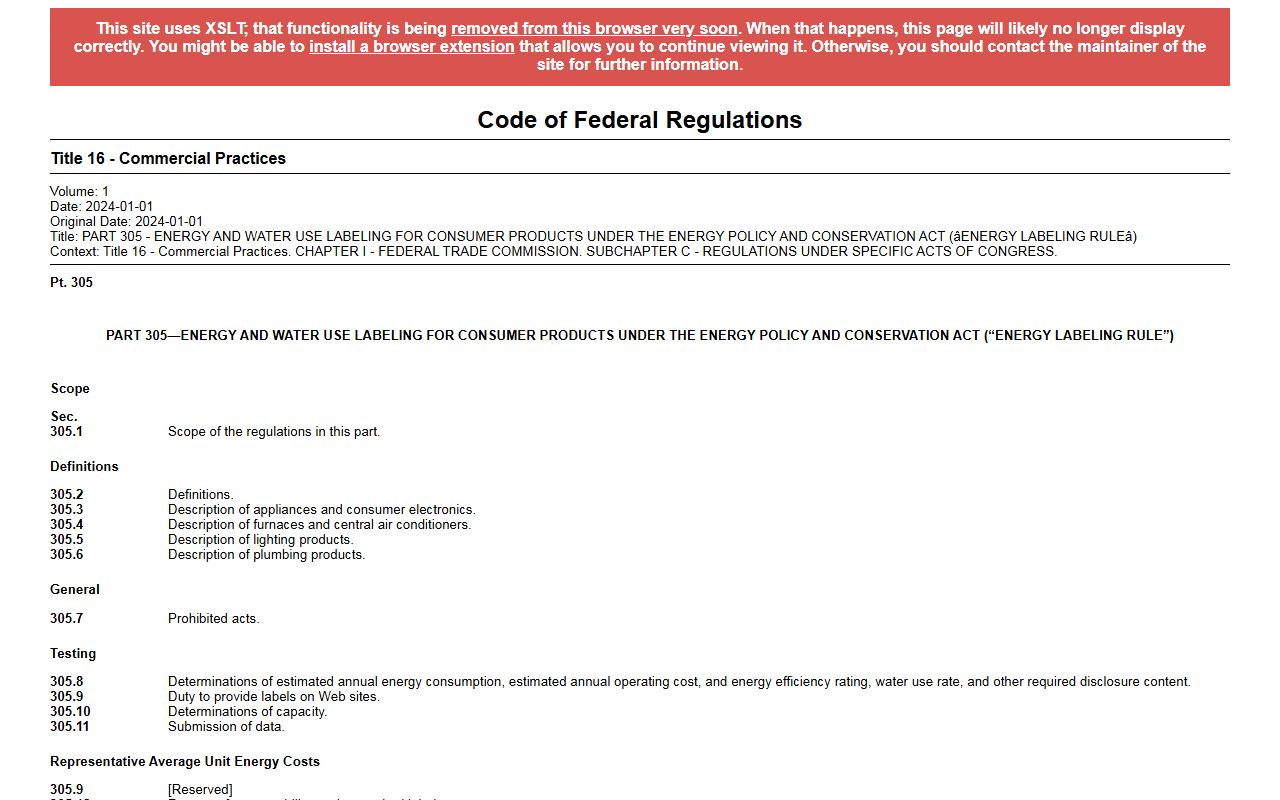
The Federal Trade Commission's appliance labelling rule, 16 CFR part 305, does not invent its own measurement. Section 305.10(l) states that capacity for ceiling fans is "the airflow in cubic feet per minute as determined according to appendix U".
Section 305.2(p) states that the energy efficiency rating for ceiling fans is "airflow efficiency". Section 305.21 is titled "Labeling for ceiling fans", though its full text was not present in the file read here.
The rule's own definition excludes the largest categories. Section 305.3(g) defines a ceiling fan as "a nonportable device that is suspended from a ceiling for circulating air via the rotation of fan blades, excluding large-diameter and high-speed small diameter fans as defined in appendix U".
ENERGY STAR adds a comparison rather than a number. Its ceiling fan page states certified fans "are up to 44% more efficient than conventional fans", and gives the specification effective date as June 15, 2018.
A 52-inch fan and a 72-inch fan from one maker
The Hunter Fonthill 52-inch page publishes a full energy block. Airflow is "5761 (CFM High)", airflow efficiency is "353 CFM / Watt", energy use is "12 Watts" and estimated yearly energy cost is "$3".
The Downtown Outdoor 72-inch page from the same maker publishes "11694 (CFM High)", "290 CFM / Watt" and "27 Watts". Both fans are listed as ENERGY STAR models.
By editorial calculation the larger fan moves 2.03 times the air of the smaller one while drawing 2.25 times the power. Its efficiency figure sits about 18 percent below the smaller fan's.
That is the trade buyers are rarely shown. Bigger blades move more air in total, and the headline efficiency figure can still fall while they do it.
The two published rows do not divide into each other
Try the arithmetic on the 52-inch fan. Dividing 5761 CFM by 12 watts gives roughly 480 CFM per watt by editorial calculation, against a published figure of 353.
The 72-inch fan behaves the same way. Dividing 11694 CFM by 27 watts gives about 433 CFM per watt, against a published 290. Neither division reproduces the maker's own number.
Appendix U explains the gap. Efficiency is the ratio of total airflow to total power consumption across the speeds the fan is required to be tested at, while the airflow row on each page is the high-speed value alone.
Neither page publishes the low-speed airflow or the low-speed wattage, so the published efficiency figure cannot be checked from the page it appears on. That is the missing row.
Appliance listings hide a required figure in the same quiet way with hose penalties and coverage claims, as SACC versus ASHRAE BTU on a portable AC spec sheet shows.
What the marketing claims on the same pages actually say
Both pages carry an efficiency claim with an asterisk. One reads "Hunter's ENERGY STAR certified ceiling fans are 64% more efficient on average than conventional fans".
Its footnote defines the comparison: "Comparing minimum efficiency standards for ENERGY STAR certified fans to non-Energy-certified fans." That is a comparison of two regulatory thresholds, not of two fans.
The airflow claim carries a different footnote. It reads "based on testing conducted January 2023 comparing the average high-speed airflow velocity of Hunter SureSpeed ceiling fans and the best-selling online models for leading competitors".
Velocity and airflow are not the same measurement. A narrow, fast column of air can beat a wide one on velocity while moving fewer cubic feet per minute overall.
Air purifier listings run the identical substitution with clean air delivery rate and air changes per hour, which is why how to read an air purifier spec sheet starts with the test conditions.
What to look for on a ceiling fan page
- Airflow at high speed in CFM, with the speed setting named rather than implied.
- Airflow at low speed, which the federal method requires for ordinary household fans and which neither page here publishes.
- Airflow efficiency in CFM per watt, remembering it pools speeds and will not equal the high-speed division.
- Wattage at the stated speed, and an estimated yearly cost with the electricity price it assumes.
- Blade span, since efficiency and total airflow move in opposite directions as span grows.
- Separate warranty terms for motor and light kit. Hunter lists a limited lifetime motor warranty and a three-year light kit warranty.
The last row is the one buyers discover late. Split warranty terms inside one product are standard across home appliances, as what appliance warranty pages leave out sets out.
Frequently asked questions
How many CFM does a ceiling fan need?
Neither page read here states a room size for its airflow figure, so the number alone does not answer it. The Hunter fans published 5761 CFM at high speed for a 52-inch fan and 11694 CFM for a 72-inch fan, as of October 2026.
Why can I not divide CFM by watts to get CFM per watt?
Because appendix U defines efficiency as total airflow over total power consumption across the required test speeds, while product pages publish the high-speed airflow only. The division overstates the 52-inch Hunter fan by about 127 CFM per watt by editorial calculation.
Is a bigger ceiling fan more efficient?
Not on these two pages. The 72-inch fan moves 2.03 times the air of the 52-inch fan by editorial calculation but publishes 290 CFM per watt against 353, roughly 18 percent lower.
What does ENERGY STAR certification guarantee on a ceiling fan?
ENERGY STAR states its certified ceiling fans "are up to 44% more efficient than conventional fans", with a specification effective date of June 15, 2018. It is a threshold claim, not a measurement of the specific fan you are reading about.
Does the airflow figure cover the fan on its lowest speed?
No. Both Hunter pages label the row "(CFM High)". Appendix U requires low-speed small-diameter fans to be tested at both low and high speed, but neither page publishes the low-speed result.
Is airflow velocity the same as airflow?
No. The marketing footnote on these pages compares "average high-speed airflow velocity", which measures how fast air moves at a point. Airflow in CFM measures how much air moves in total, and a fan can win on one and lose on the other.
Bottom line
A complete ceiling fan listing states airflow at high and low speed, wattage at each, airflow efficiency in CFM per watt, blade span and both warranty terms. Neither page read on October 23, 2026 publishes the low-speed pair.
Compare efficiency figures with efficiency figures and ignore any claim built on velocity. The same discipline sorts out humidity ratings in what dehumidifier pint ratings actually mean.
It also sorts out suction and coverage claims. Robot vacuum suction claims, decoded and how to read a scent diffuser spec sheet both begin with the condition the headline omits.
Sources
- 10 CFR part 430, subpart B, appendix U - uniform test method for measuring the energy consumption of ceiling fans (checked Oct 23, 2026)
- 16 CFR part 305 - FTC appliance labeling rule, ceiling fan definitions and capacity (checked Oct 23, 2026)
- ENERGY STAR - ceiling fans product page and specification effective date (checked Oct 23, 2026)
- Hunter Fonthill Indoor 52 inch ceiling fan product page (checked Oct 23, 2026)
- Hunter Downtown Outdoor ENERGY STAR 72 inch ceiling fan product page (checked Oct 23, 2026)