What Amplifier and Soundbar Watt Claims Mean
One AV receiver is sold as a 75W model in one country and a 140W model in another, and its own spec table lists three different wattages. A federal rule explains which figure counts.
This article is a documentation review: it is based on the vendors' own published pages, checked on the date shown. We may earn a commission from some links; it never affects what we recommend.
An amplifier's wattage is not one number. It is a number plus four conditions, and changing any condition changes the figure a maker is allowed to print on the box.
A federal rule sets out which of those figures has to come first. This guide reads that rule, then holds three current product pages against it: two AV receivers and one flagship soundbar.
Every figure below comes from the Code of Federal Regulations or the makers' own pages, checked October 23, 2026. Where a page omits a row, this guide says so rather than guessing.
The rule names one wattage and puts it ahead of the others
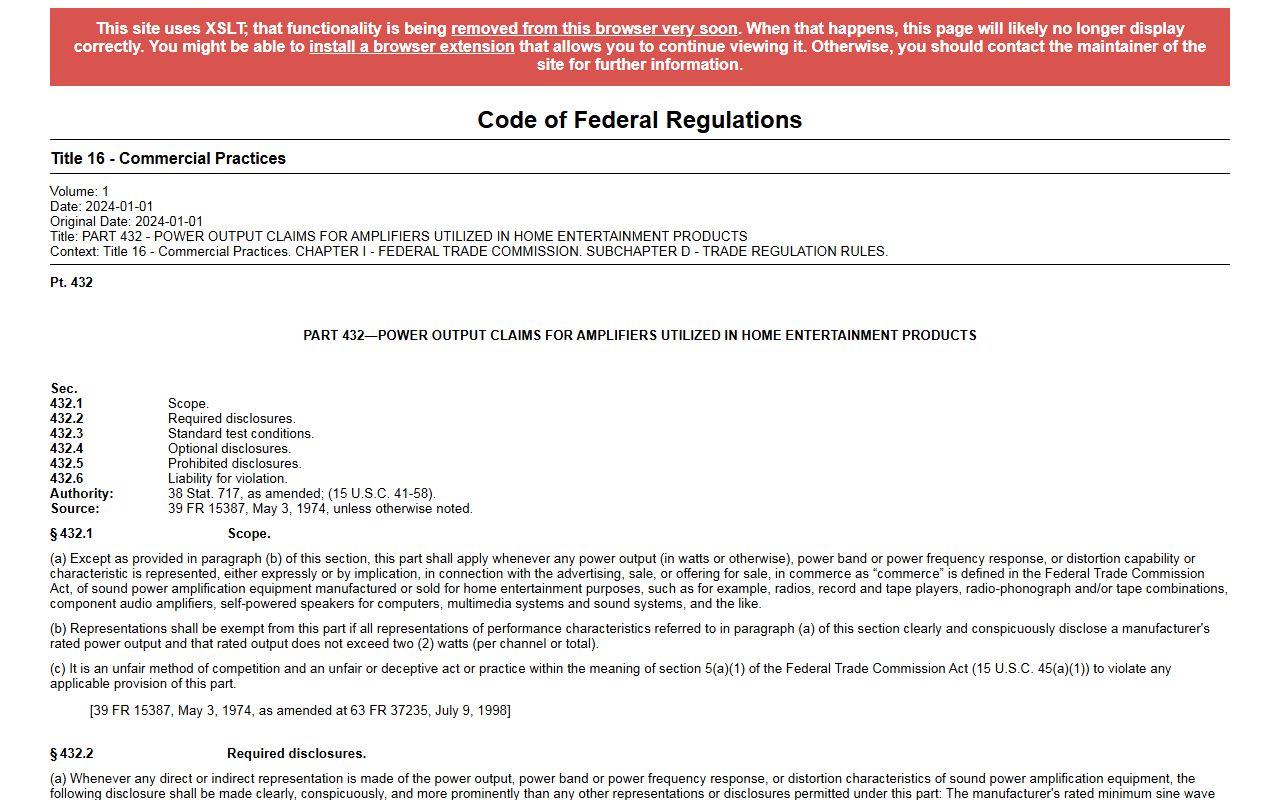
Part 432 of title 16 of the Code of Federal Regulations covers power output claims for amplifiers. Its scope reaches "sound power amplification equipment manufactured or sold for home entertainment purposes".
The scope text then lists examples: "radios, record and tape players, radio-phonograph and/or tape combinations, component audio amplifiers, self-powered speakers for computers, multimedia systems and sound systems, and the like". The word soundbar does not appear.
Section 432.2(a) names the figure that has to lead. It is "the manufacturer's rated minimum sine wave continuous average power output, in watts, per channel at an impedance of 8 ohms".
Two qualifiers in that sentence do the work. If the amplifier is not designed for 8 ohms, the figure is taken "at the impedance for which the amplifier is primarily designed".
And it is "measured with all associated channels fully driven to rated per channel power". A figure taken with one channel driven is a different and easier measurement.
The rule also sets how prominent that figure must be. It has to appear "clearly, conspicuously, and more prominently than any other representations or disclosures permitted under this part".
Two more rows have to travel with the wattage
Section 432.2(b) adds the context that makes a wattage checkable. Paragraph (b)(1) requires "the manufacturer's rated power band or power frequency response, in Hertz (Hz)".
Paragraph (b)(2) requires "the manufacturer's rated percentage of maximum total harmonic distortion". Without those two rows, a watt figure cannot be reproduced or compared with a rival's.
Section 432.3 fixes the test conditions. Power line voltage is set at "120 volts AC" RMS for domestic equipment, at a frequency of "60 Hz", with 230 volts named for foreign equipment.
Paragraph (c) requires preconditioning "at one-eighth of rated power output for one hour" before the measurement. A cold amplifier and a warm one do not deliver the same output.
Paragraph (e) closes the loophole that matters most. The rated power must be obtainable "at all frequencies within the rated power band" without exceeding the stated distortion limit, not only at a convenient frequency.
One Denon receiver carries three wattages and two headlines
The US page for the Denon AVR-S670H is titled "5.2 Ch. 75W 8K AV Receiver". Its specification table lists three power rows, not one.
- Power Output (8 ohm, 20 Hz - 20 kHz, 0.08% 2ch Drive): 75 W
- Power Output (6 ohm, 1 kHz, 0.7% 2ch Drive): 100 W
- Power Output (6 ohm, 1 kHz, 10% 1ch Drive): 150W
Those three figures describe one amplifier. The 75 W row is the one measured across the full audio band at 8 ohms with low distortion, which is the shape of figure section 432.2(a) describes.
The 150 W row drops to a single frequency, a lower impedance, one channel driven and ten percent distortion. By editorial calculation it is double the 75 W figure, and it is the headline a looser page would print.
A looser page exists. The global Denon page for the same model is titled "5.2 Ch. 140W 8K AV Receiver" and its comparison block states "140 Watts per Channel".
The specification table further down that same page lists 75 W at 8 ohms, 100 W at 6 ohms and 135W at 6 ohms with one channel driven. The 140 W headline matches none of its own rows.
Yamaha publishes the conditions but not the same impedance twice
The Yamaha RX-V6A specification page uses one row label for both models it compares: "Rated Output Power (20Hz-20kHz, 2ch driven)". The band and the channel count sit in the label itself.
The RX-V6A figure is "100 W (8 ohms, 0.06% THD)". The RX-V4A figure on the same table is "80 W (6 ohms, 0.06% THD)". Both carry a distortion figure and a full-band measurement.
The impedance differs between them, so the two numbers are not a clean comparison even on one maker's own page. The receivers are listed as 7.2 and 5.2 channels respectively.

The flagship soundbar page publishes no output wattage at all
The Samsung HW-Q990F page carries a full specification table with dimensions to the millimetre and weights to the tenth of a kilogram. Its "Power" section lists consumption only.
- Operating Power Consumption (Main): 41 W
- Operating Power Consumption (Rear): 19 W (Lch) / 19 W (Rch)
- Operating Power Consumption (Subwoofer): 48 W
- Stand-by Power Consumption: 0.5 W for the main unit, each rear speaker and the subwoofer
By editorial calculation the four operating figures add to 127 W of draw from the wall for the whole 11.1.4 system. No audio output wattage appears anywhere on the page.
Large total-watt numbers are quoted for this model in third-party listings. None of them was present in the page read on October 23, 2026, so none is reported here.
A power consumption figure is not an output figure, and the two are often close enough in size to be mistaken for each other. The same confusion runs through portable power station numbers that matter.
What to read before you trust a watt figure
- Find the impedance. An 8-ohm figure and a 6-ohm figure for the same amplifier are not the same claim.
- Find the frequency band. A figure quoted at 1 kHz only is easier to hit than one held across 20 Hz to 20 kHz.
- Find the distortion percentage. The Denon table runs from 0.08 percent to 10 percent across its three rows.
- Count the channels driven. One channel driven is the gentlest version of the test.
- Check whether the headline matches any row in the table below it. On one page read here, it did not.
- On a soundbar, check whether the number is output or consumption. Samsung's page publishes only consumption.
None of those rows is expensive to publish, which makes their absence a choice. Warranty pages behave the same way, as what appliance warranty pages leave out sets out in detail.
Headphone listings compress the problem into even fewer rows. How to read a wireless headphone spec sheet separates the figures with a measurement behind them from the decorative ones.
Frequently asked questions
Which wattage figure should I compare between two AV receivers?
The one measured across 20 Hz to 20 kHz at 8 ohms with all channels driven and a stated distortion limit. Section 432.2(a) of 16 CFR 432 describes that figure and requires it to be shown more prominently than any other.
Why does the same receiver show 75W and 140W?
Because the conditions differ. Denon's US page titles the AVR-S670H a 75W model and its table shows 75 W at 8 ohms across the full band. The global page for the same model is titled 140W, a figure that matches none of its own spec rows.
What does peak or total power mean on a soundbar box?
The pages read here do not define it. The Samsung HW-Q990F page published no output wattage at all on October 23, 2026, only operating consumption of 41 W, 19 W per rear speaker and 48 W for the subwoofer.
Does the FTC amplifier rule apply to soundbars?
The scope text covers "sound power amplification equipment manufactured or sold for home entertainment purposes" and lists "multimedia systems and sound systems, and the like". It does not use the word soundbar, so this guide reports the wording rather than ruling on it.
Is a 150W receiver louder than a 100W receiver?
Not reliably, because the two figures may come from different tests. On the Denon US table, 150W is taken at one frequency with one channel driven at ten percent distortion, while 100 W is a two-channel figure at 0.7 percent.
Why does distortion percentage matter in a power rating?
Because allowing more distortion allows a bigger number. Section 432.2(b)(2) requires the rated maximum total harmonic distortion to be disclosed, and section 432.3(e) requires the rated power to hold across the whole rated band within that limit.
Bottom line
A watt figure you can act on carries four companions: impedance, frequency band, distortion limit and channels driven. The federal rule asks for three of them in writing and asks for the strict figure to lead.
Two of the three pages read on October 23, 2026 publish all four conditions. The soundbar page publishes no output figure at all, which is more honest than a number with no method behind it.
Read the table rather than the title, and check that the title appears in the table. That one habit also catches the gap in SACC versus ASHRAE BTU on a portable AC spec sheet.
It catches inflated endurance claims too. What SSD endurance ratings actually promise and robot vacuum suction claims, decoded both hinge on a condition the headline hides.
Sources
- 16 CFR part 432 - Power Output Claims for Amplifiers Utilized in Home Entertainment Products (checked Oct 23, 2026)
- Denon AVR-S670H, United States product page and specification table (checked Oct 23, 2026)
- Denon AVR-S670H, global product page with 140W headline (checked Oct 23, 2026)
- Yamaha RX-V6A and RX-V4A specification comparison page (checked Oct 23, 2026)
- Samsung HW-Q990F soundbar product page, power consumption rows (checked Oct 23, 2026)