What SSD Endurance Ratings Actually Promise
Two numbers end an SSD warranty and the first one to arrive wins: a year count and a write budget printed as TBW. This guide reads the endurance rows on the Samsung 990 PRO, the WD_BLACK SN850X and the Solidigm D7-PS1010 against the JEDEC standard that defines how such ratings are produced, checked October 15, 2026.
This article is a documentation review: it is based on the vendors' own published pages, checked on the date shown. We may earn a commission from some links; it never affects what we recommend.

Two numbers end an SSD warranty, and the first one to arrive wins. One is a year count. The other is a write budget, printed as TBW for terabytes written. Samsung states both in a single line on its 990 PRO page, and the word joining them matters more than either figure. This guide reads the endurance rows on three current product pages, the Samsung 990 PRO, the WD_BLACK SN850X and the Solidigm D7-PS1010, against the JEDEC standard that defines how such ratings are produced. Every figure below is quoted from a maker's or JEDEC's own page, checked October 15, 2026.
TBW is a warranty ceiling, not a failure date
Samsung prints the pair outright. The 990 PRO 2TB page lists "5-Year Limited Warranty" followed immediately by "or 1200 TBW Limited Warranty", checked October 15, 2026.
That "or" is the whole specification. Cover ends at five years or at 1,200 terabytes written, whichever arrives first, and nothing on the page suggests the drive stops working at either boundary.
Western Digital uses the same structure. The WD_BLACK SN850X page carries "5-Year Limited Warranty" against each model code and a separate "Endurance (TBW)" row for every capacity.
JEDEC publishes the method behind those figures. Its standard JESD219A.01, published June 2022, "defines workloads for the endurance rating and endurance verification of SSD application classes", to be used alongside JESD218.
So an endurance rating describes a tested workload and a contractual boundary. What ends at the number is the maker's obligation, not the hardware.
Endurance scales with capacity, so one headline figure is not the product
Western Digital publishes the full ladder rather than a single banner number. On the SN850X page the "Endurance (TBW)" row reads 600 at 1TB, 1200 at 2TB, 2400 at 4TB and 4800 at 8TB, checked October 15, 2026.
That works out to exactly 600 terabytes written per terabyte of capacity at every rung, by editorial arithmetic. Samsung's 2TB figure of 1,200 TBW sits on the same ratio, which makes the two families directly comparable on this row.
The practical consequence is that a bigger drive buys proportionally more write budget, not only more room. A marketing line quoting "up to 4,800 TBW" with no capacity attached tells a buyer nothing at all.
Before comparing two drives, copy down all of this:
- Capacity of the exact model, because endurance is published per capacity
- TBW at that capacity, not the top of the family range
- Warranty in years, plus the wording that joins it to the TBW figure
- Whether the page publishes DWPD instead of TBW
- MTBF in hours, and whether the page labels it as a population figure
- Sequential read and write in MB/s, with the capacities those speeds apply to
- Form factor and thickness, which decide whether it fits a laptop at all
Turn the write budget into years using your own rate
The arithmetic takes a minute and often settles the purchase. By editorial arithmetic, 1,200 TBW spread evenly across five years is 240 terabytes a year, or roughly 657 gigabytes every single day.
Ordinary desktop use is nowhere near that. Someone writing 20 gigabytes a day would need about 164 years to reach 1,200 terabytes, by the same arithmetic, so the five-year clock is the limit that actually binds.
Video editing, database work and repeated game reinstallation are the cases that move the needle. For those workloads the TBW ladder, not the year count, decides which capacity is the right buy.
Specs that scale with size behave this way across categories. The same per-unit arithmetic is what makes a printer's yield claim usable, as set out in how to read printer page yield.
DWPD states the same budget as a daily allowance
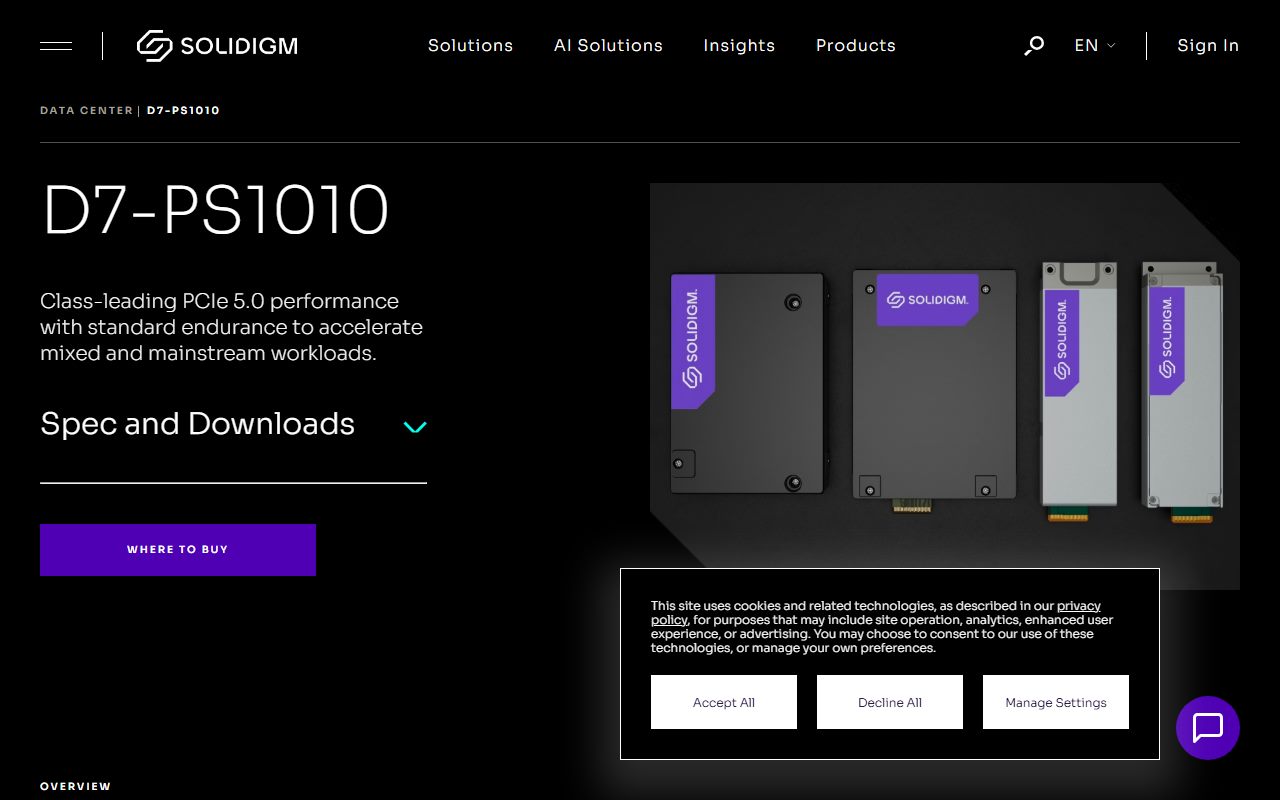
Enterprise pages swap the unit. Solidigm's D7-PS1010 page lists "Endurance Rating (Lifetime Writes) 1 DWPD / 28 PBW" for the 15.36TB model, checked October 15, 2026.
One drive write per day on 15.36 terabytes comes to 28,032 terabytes across five years, by editorial arithmetic, which is the 28 petabytes the page prints. The five-year window is implied by the pairing and never written down.
That is why a lone DWPD figure is incomplete. A daily allowance only converts into a total once a term is attached, and the term is the part most often left off a summary.
The Samsung and Western Digital pages read for this guide print no DWPD row anywhere. Comparing a consumer drive against a data centre drive therefore means doing the conversion yourself, from the warranty term up.
MTBF is a population statistic and not a lifespan
Samsung lists "1.5 Million Hours Reliability (MTBF)". Solidigm lists "2.5 million hours" for the same row. Both are accurate and both invite the same misreading.
One and a half million hours is about 171 years, by editorial arithmetic. No maker is promising that. The figure describes failure frequency across a large population over a short observation window, not the service life of one drive in one computer.
The SN850X page read for this guide prints no MTBF row, and we could not find the figure in Western Digital's published product page as of October 2026. Its absence is not a fault, but it does remove one axis of comparison.
Rows that look like guarantees and are really test conditions turn up on every kind of spec sheet. The clearest example on this site is the millisecond response figure covered in monitor specs that change what you actually see.
Read the speed rows with the same suspicion as the endurance rows
Samsung states "Sequential read speeds up to 7,450 MB/s and sequential write speeds up to 6,900 MB/s". Western Digital states "7,300MB/s" and then attaches a condition in the same sentence: "(1TB - 4TB models)".
That parenthesis is the finding. A headline speed can belong to part of a range exactly as endurance belongs to one capacity, and the 8TB model is quietly outside it.
Sequential figures also describe the easiest possible job: one long unbroken stream. Everyday use is mostly small scattered reads, and none of the consumer pages quoted here publishes a comparable random-access figure.
A certified figure measured under a published method is the only kind worth comparing across brands. The clean example in a different category is the airflow rating in how to read an air purifier spec sheet.
Two numbers for one capability, measured differently, is the normal condition of a spec sheet rather than the exception. Cooling capacity does it too, as SACC versus ASHRAE BTU on a portable AC spec sheet shows.
Bottom line
Write down three things per drive: capacity, TBW or DWPD at that capacity, and the warranty term that bounds them. Then divide the write budget by your own daily write rate.
For most buyers the years run out long before the terabytes, which means capacity and interface deserve the money that a higher endurance tier would absorb. Heavy writers should work the ladder instead.
Where a page omits a row, treat the omission as information rather than reassurance. The same reading habit applies to a warranty clause in how to read a standing desk spec sheet and to the measurement conditions in how to read a wireless headphone spec sheet.
Frequently asked questions
Does an SSD fail once it passes its TBW rating?
Not usually. TBW is a warranty boundary, not a predicted failure point. Samsung's 990 PRO page pairs "5-Year Limited Warranty" with "or 1200 TBW Limited Warranty", so cover ends at whichever arrives first and the drive carries on at the owner's risk.
Which limit matters more, TBW or warranty years?
For ordinary use, the years. By editorial arithmetic, 1,200 TBW over five years allows about 657 gigabytes of writes a day. Someone writing 20 gigabytes a day would take roughly 164 years to reach the ceiling, so the clock expires first.
How do I convert DWPD into terabytes written?
Multiply capacity by the DWPD figure, then by 365, then by the warranty term in years. Solidigm's 15.36TB D7-PS1010 at 1 DWPD gives 28,032 terabytes over five years by editorial arithmetic, which matches the 28 PBW printed on the page.
Does a 1.5 million hour MTBF mean the drive lasts 171 years?
No. That conversion is arithmetically correct and practically meaningless. MTBF describes failure frequency across a large population of drives over a short test window, not the expected service life of a single unit.
Do larger SSDs really last longer?
They carry a larger write budget. The WD_BLACK SN850X endurance row runs 600 TBW at 1TB up to 4800 TBW at 8TB, which is a flat 600 terabytes written per terabyte of capacity by editorial arithmetic. The warranty term does not change with size.
Why do consumer drives publish TBW and data centre drives publish DWPD?
They answer different questions. A home buyer wants a lifetime total; a data centre operator wants a per-day budget to plan against. The underlying JEDEC endurance workloads, defined in JESD219A, sit behind both figures.
Sources
- Samsung 990 PRO PCIe 4.0 NVMe SSD 2TB product page (checked Oct 15, 2026)
- WD_BLACK SN850X NVMe SSD product page (checked Oct 15, 2026)
- Solidigm D7-PS1010 specifications (checked Oct 15, 2026)
- JEDEC JESD219A.01, Solid-State Drive (SSD) Endurance Workloads (checked Oct 15, 2026)